
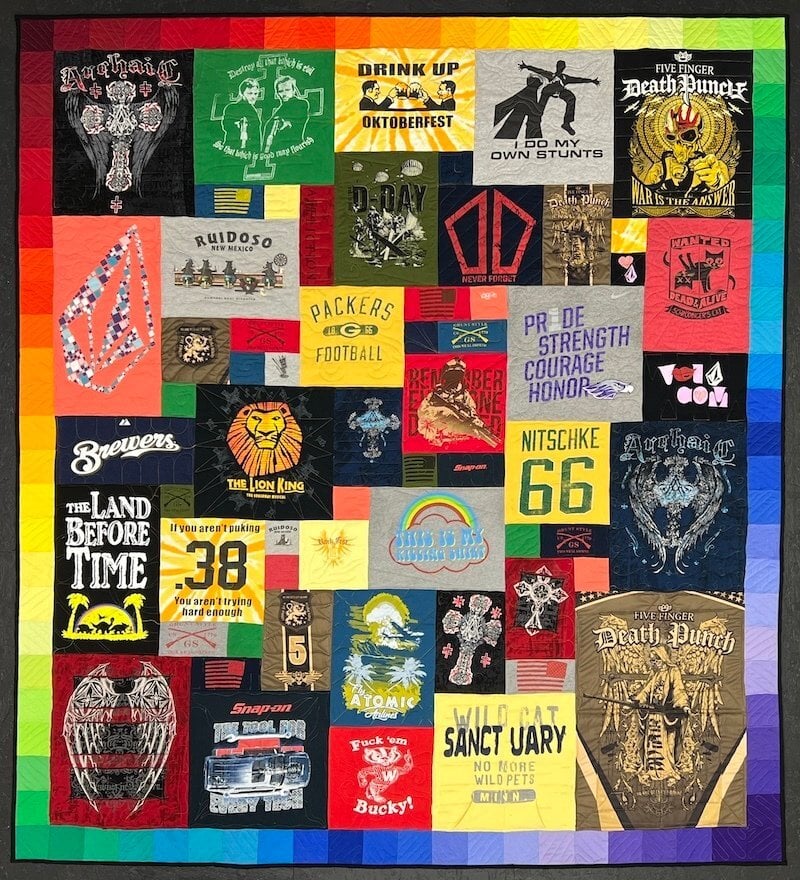
What makes a great T-shirt quilt isn’t the sewing. It’s the design. Learn how color balance, graphic placement, movement, and custom layouts turn random T-shirts into cohesive quilts.
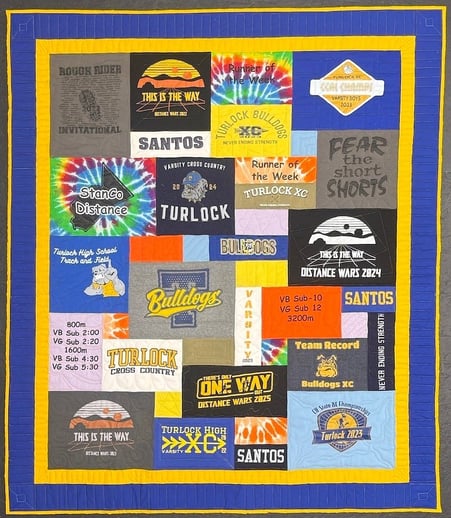 Most people assume making a T-shirt quilt is about sewing. It’s not. The real challenge starts long before the first stitch.
Every T-shirt collection is different. Some have bright colors. Some are mostly black shirts. Some include tiny logos mixed with oversized graphics. Others combine shirts from completely different periods of life that were never meant to visually work together.
That’s where design matters.
At Too Cool T-shirt Quilts, we believe the difference between an average T-shirt quilt and one that feels intentional comes down to one thing:
The ability to design around the shirts you have.
No Two T-shirt Collections Are Ever the Same
 As there are no two people the same, no two T-shirt collections are the same. We love to celebrate how different we all are!
Most quilt layouts are designed around efficiency and repetition. But real T-shirt collections rarely cooperate with cookie cutter layouts. That’s why custom design matters.
We start where you are and with the belief that we can and will make any group of T-shirts into a quilt that looks awesome.
The Design Problems Most People Never Notice
Color Balance
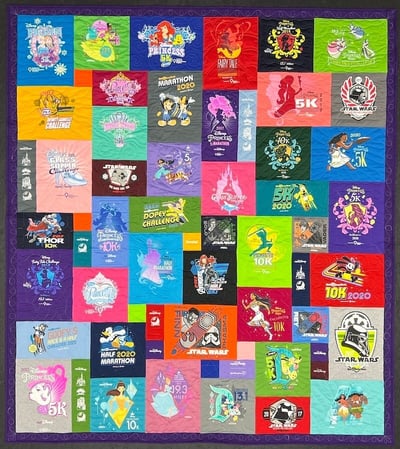 Any design solution, successful or not in other categories, can fail if the colors of the T-shirts are not balanced. For example, if all the red blocks in the quilt are congregated in one area of the quilt, the quilt will be unbalanced.
A quilt maker must be skilled enough to spread the various color T-shirt blocks evenly throughout the quilt. Spend time looking at photos of T-shirt quilts. Squint your eyes and look to see if any globs of colors stick out. If so, the quilt is not as successful as it could have been.
Many quilts made of uniform size blocks laid out in rows and columns will look unbalanced. You could lay them out in a dark/light checkerboard pattern, but if there are more darks than lights, this pattern can’t hold.
Graphic Size
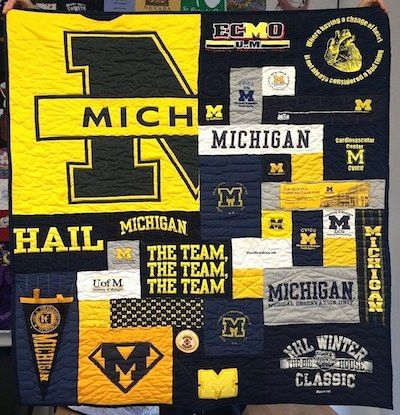 Some T-shirts have huge designs and others have tiny designs. It takes experience to integrate all sizes of designs into one quilt.
The University of Michigan quilt here is a great example of mixing large and small design.
I placed the yellow half M in the upper right hand corner of the quilt. I like how this block tells us what the quilt is about. I also like how the bottom of the M and the text "MICH" lead your eye over to the part of the quilt with the smaller graphics.
A quilt maker without graphic design experience might have put the M in the center of the quilt. That would have made the M the only part of the quilt you would look at - it would dominate the quilt.
Movement and Flow
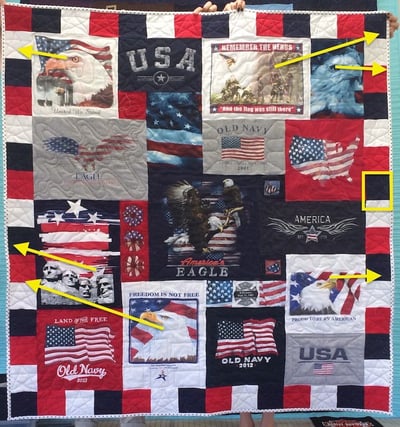 Most people don't realize that a T-shirt has direction. That direction is how the graphics guide your eyes across the quilt.
Let's look at this USA quilt that we long-arm quilted for another quilt maker.
The yellow arrows point from a graphic to where it directs your eye. So many of the designs send your eye off the quilt. And when your eye tracks off the quilt, there might be something more interesting over there to look at.
As a quilt maker, I want to keep your eyes on the quilt. I want you to stay involved and interested. This is an important design concept.
Creating Cohesion From Unrelated T-shirts
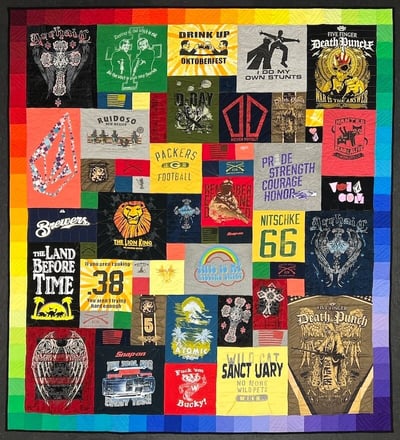 Our goal is not simply fitting T-shirts together. Our goal is to make them feel like they belong together.
We have some tricks we use to balance colors throughout the quilt. Look at this quilt here. It only has one graphic in green. Top left part of the quilt. Just one green block.
But it doesn’t feel like that when you look at the quilt! We added small green blocks throughout the body of the quilt. That paired with the green in the border hide the fact there is just one green block with a graphic on it.
This is just one example of how we merge random groups of T-shirts into a cohesive quilt.
Why We Love Difficult Quilt Designs
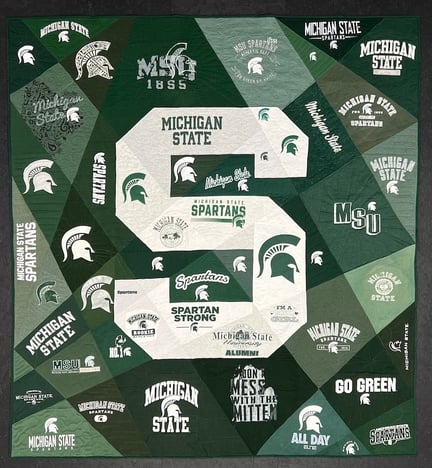 I am a graphic designer (MA Michigan State University) who loves making T-shirt quilts more than creating logos or other traditional graphic design functions. Go green!
The quilts we enjoy designing most are usually the ones that look impossible at first.
-
The collections with clashing colors.
-
The oversized graphics.
-
The shirts customers worry won’t work together.
Those are the quilts that allow creativity and experience to matter most. Every challenging collection becomes a design puzzle. And after decades of designing T-shirt quilts, solving those puzzles is still our favorite part of the process.
Planning a T-shirt quilt?
Here are step-by-step directions for ordering your Too Cool T-shirt quilt.

Our Quilt Styles Were Created to Solve Different Design Challenges
Since the early 1990s I have challenged the status quo in the quilting world. Not for the fun of it. I challenged the traditional style of T-shirt quilt making because it doesn't work. It did not solve the problems that a T-shirt quilt must solve.
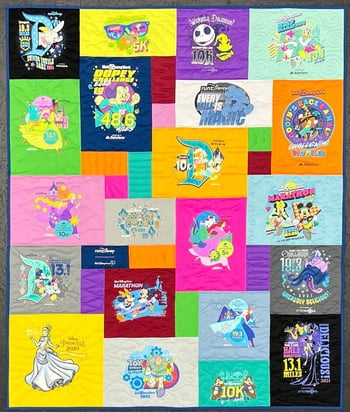 Here's an explanation of each of our styles and each is illustrated with a quilt made from runDisney T-shirt. This lets you see the difference between the styles with a similar group of T-shirts.
Standard Puzzle Style
This was my first major improvement to traditional T-shirt quilt design. It let all the blocks in the quilt fit the graphic on the T-shirts. I never even considered cropping off a graphic on a T-shirt - just was not going to happen. Thus the puzzle style was born.
This is the style most of our quilts are made in.
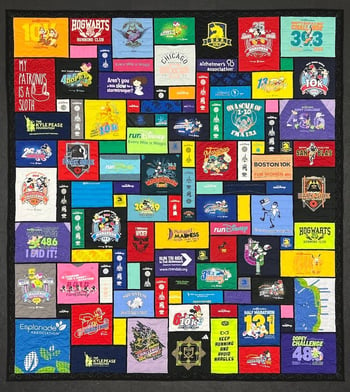 Stained Glass Puzzle Style
The stained glass puzzle style is an offshoot of the standard puzzle style. It gave me another design element - the thin strip of material between the blocks. We call this leading - like a stained glass maker uses.
We can use the color of leading to create a different feel depending on the group of T-shirts we are using.
Ultra Modern Styles
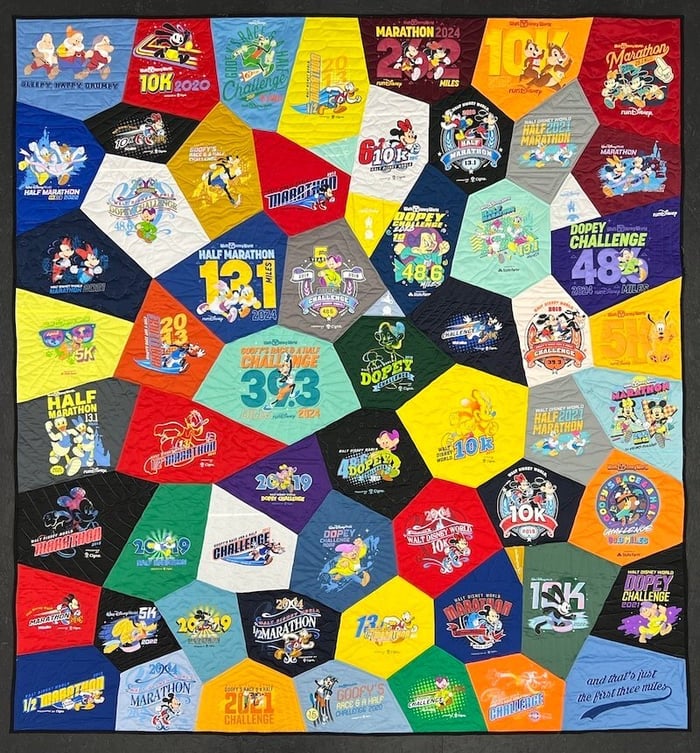
These are our newest style of T-shirt quilts. There are over 20 subsets to the ultra modern style. You can see some of the other great ultra modern quilts here. The one here is a Flagstone style.
This new style lets us push our T-shirt quilt design skills even further.
The Difference Between Sewing and Designing
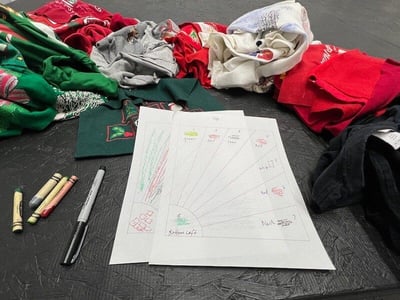 Anyone can sew T-shirts together into rows. But designing a quilt that feels balanced, cohesive, and visually interesting takes experience and time.
Good design means:
-
knowing which T-shirts should stand out
-
understanding how color placement affects the entire quilt
-
creating movement across the layout
-
avoiding visual clutter
-
making unrelated shirts feel connected
That’s the part of T-shirt quilt making we’ve spent decades refining. And it's what takes the most time in making a T-shirt quilt. Sewing is not first... it's about 7th or 8th in our process!
Why Cookie Cutter Layouts Don’t Work for Most T-shirt Collections
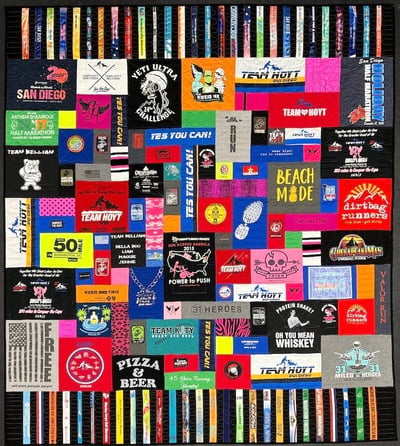 Traditional style T-shirt quilts don't solve the problems that all T-shirt quilts must solve. They just sew the T-shirts together into a grid of rows and columns. The unique factors of the T-shirts are not taken into consideration. For some people, that's all they want. And it's ok with them that the quilt or blanket is not artistically designed.
But most real-life T-shirt collections are far more complicated and a traditional style T-shirt quilt is not the right solution. That’s why we approach every quilt individually and continue developing new ways to design T-shirt quilts.
Your T-shirts determine the design direction, not the other way around.
The Best T-shirt Quilts Feel Designed, Not Assembled
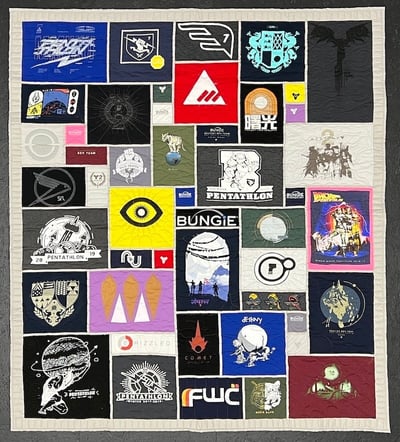 Your T-shirt quilt should feel personal and different than someone else's T-shirt quilt. Not because of the T-shirts alone, but because of how those shirts come together as a whole.
That’s why design matters. And it’s why we still get excited about the challenge every time a new box of T-shirts arrives.
Want to learn more about T-shirt quilts? Visit our Learning Center.
We have over 200 articles about all aspects of T-shirt quilts.
