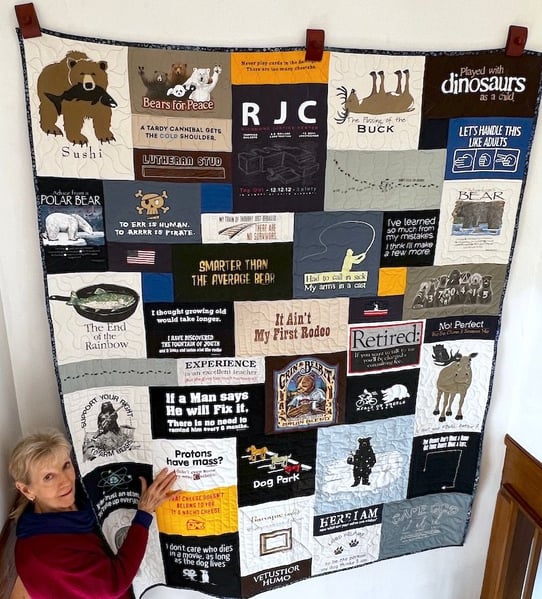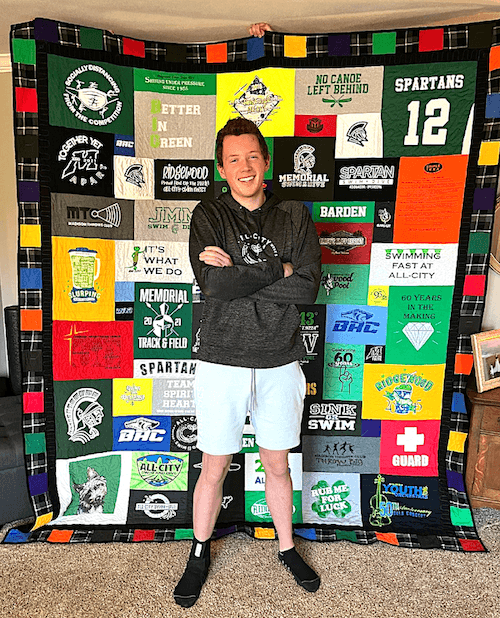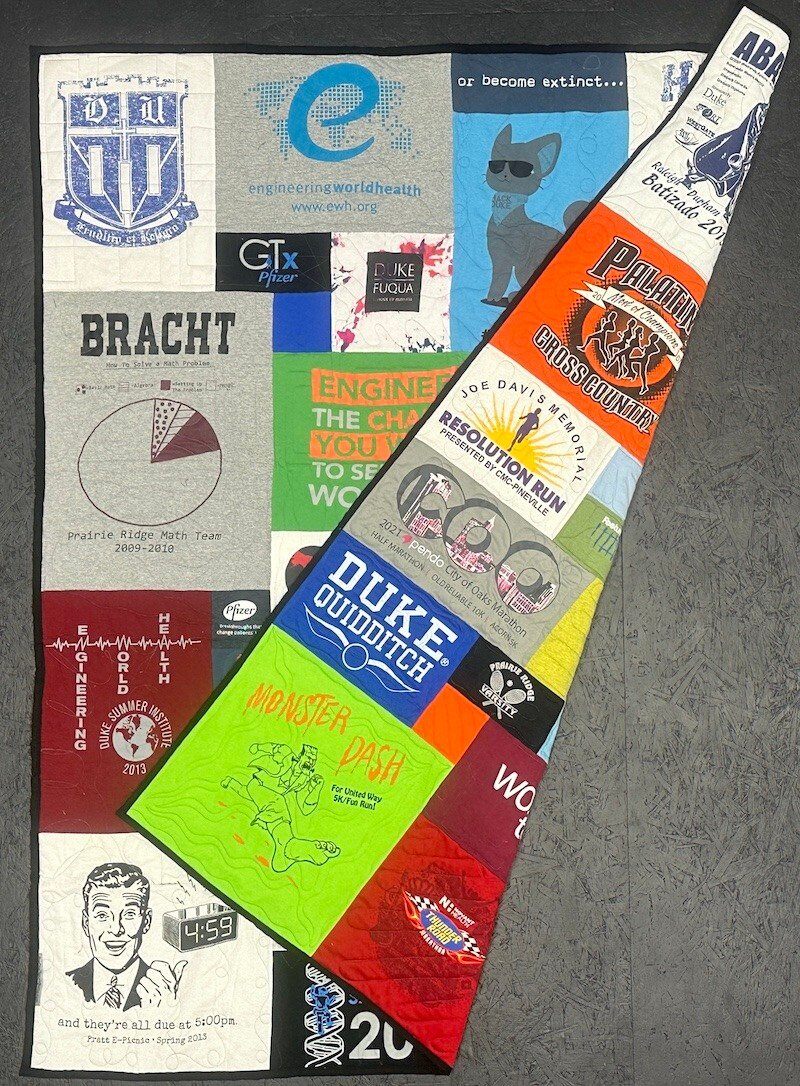
There are a lot of choices when it comes to T-shirt quilts. Styles, construction methods, materials, companies and what even qualifies as a quilt can vary widely.
This page brings those comparisons together in one place. Use it to explore the differences and understand your options.
Find the topic you want to learn more about, open the question for a short answer, then follow the link there for a more complete explanation.
Comparing Types and Styles of T-shirt Quilts
Comparing Construction Methods
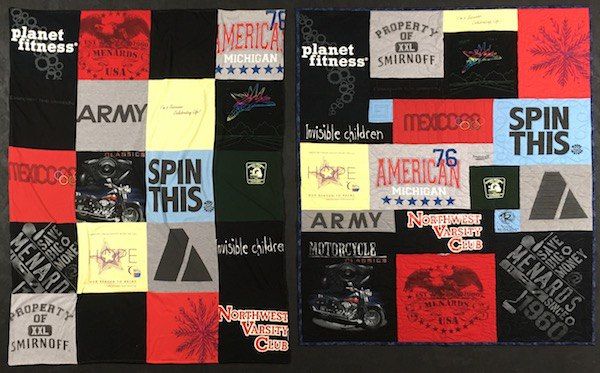
A T-shirt quilt has three layers: T-shirts on top, batting in the middle, and backing fabric on the bottom. Those three layers are held together with quilting stitches.
A T-shirt blanket usually has two layers: T-shirts on the front and fleece or another fabric on the back, without quilting holding the layers together.
The construction, feel, price and longevity can be very different.
Learn more about the differences between T-shirt quilts and T-shirt blankets.
Blanket left, quilt right.

Traditional grid-style T-shirt quilts use blocks that are all the same size and are arranged in rows and columns. This can mean cutting a large design down to fit the block or leaving extra blank fabric around a smaller design.
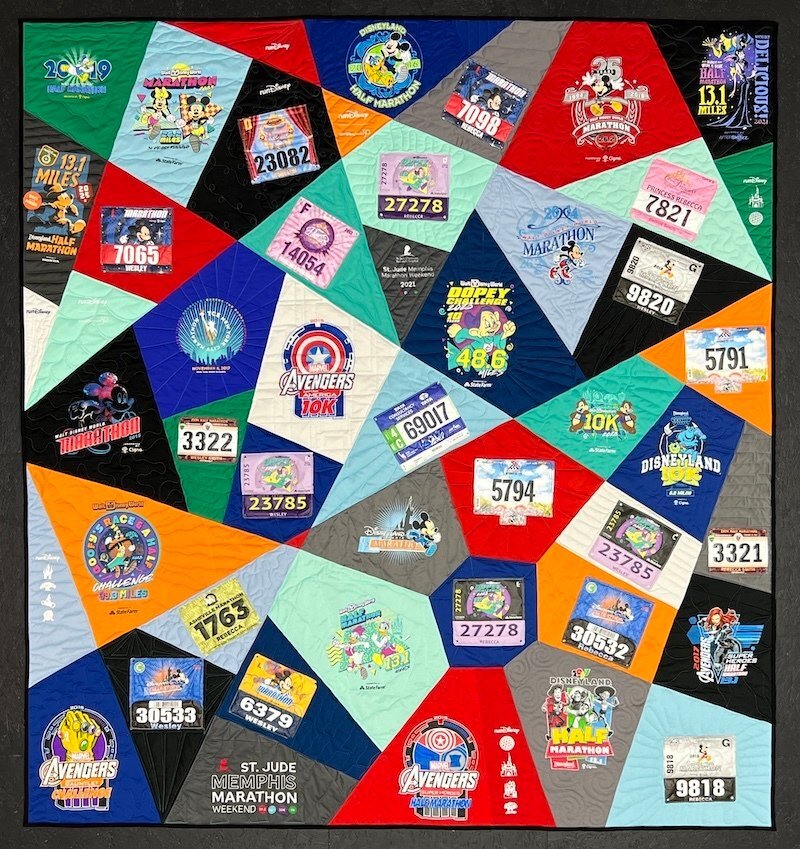
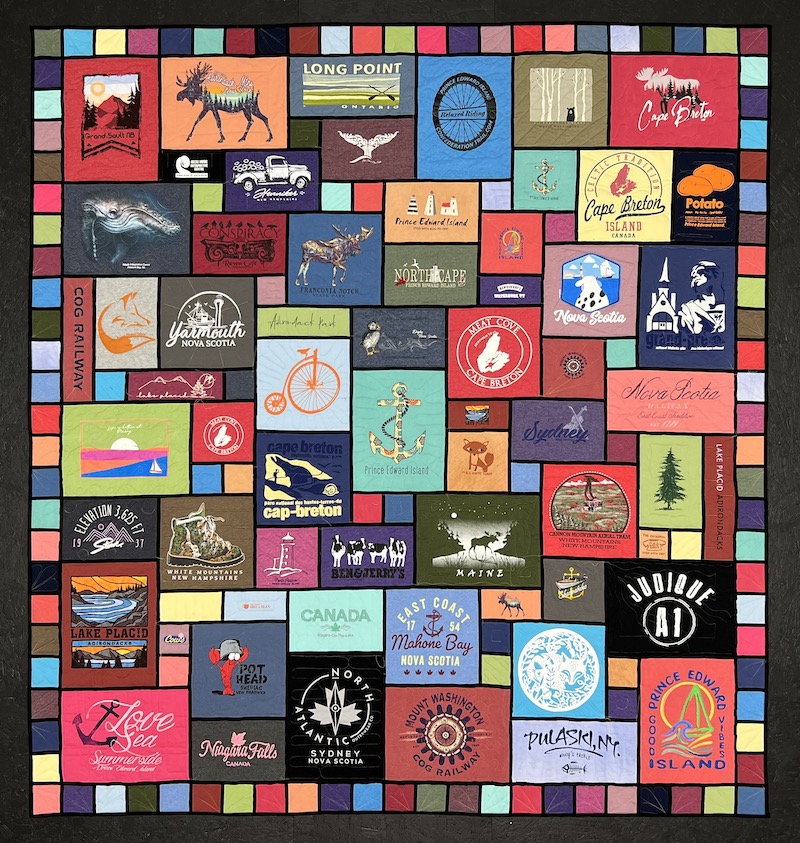
Puzzle-style T-shirt quilts use different-size blocks based on the size and shape of each T-shirt graphic. The blocks fit together like a puzzle, allowing more of each design to be used without forcing every graphic into the same-size block.
See how puzzle-style T-shirt quilts are different from traditional T-shirt quilts.
A single-sided T-shirt quilt has T-shirts on the front and backing fabric on the back. This lets you see the quilting designs clearly on the back of the quilt.
A double-sided T-shirt quilt has T-shirts on both the front and back, allowing you to include more T-shirts in one quilt. The tradeoff is that much of the quilting is less visible among the T-shirt graphics.
Learn more about double-sided T-shirt quilts and which option might work for you.

Puzzle-style T-shirt quilts use different-size blocks based on the size and shape of the graphics, with the blocks fitted together like a puzzle. The T-shirt graphics remain the focus of the design.
Ultra Modern T-shirt quilts take a different approach. The T-shirts become part of an overall design, using shapes, curves and other design elements that go beyond traditional T-shirt quilt layouts.
Compare our T-shirt quilt styles and see examples of each.

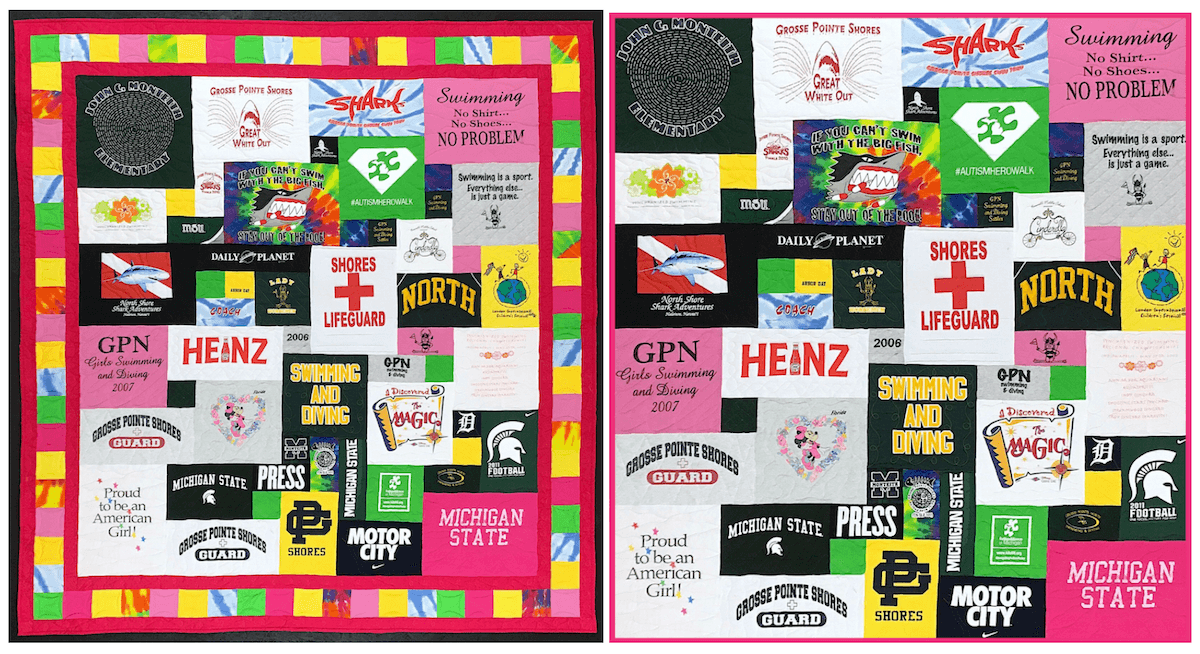
A border changes the finished look of a T-shirt quilt. It add color, frames the T-shirt designs, or makes the quilt larger. Without a border, the T-shirts extend to the edge of the quilt for a simpler look.
There are also several border styles and widths to choose from, so the decision isn't just whether to add a border, but what type of border works best with your quilt.
How to Decide If You Want a Border on Your T-shirt Quilt

Some T-shirt quilt makers apply iron-on interfacing to the back of the T-shirts to make the stretchy fabric easier to sew. Some quilts just don't know that it's not necessary.
Other construction methods allow T-shirts to be sewn without adding interfacing.
We don't use interfacing in our T-shirt quilts. With the right sewing techniques, T-shirt fabric can be handled successfully without adding another layer to the quilt.
Learn more about interfacing and why we don't use it in our T-shirt quilts.
Some T-shirt quilt companies require you to cut your T-shirts before sending them in. Others ask you to send the T-shirts whole and they will do all the cutting for you.
At Too Cool T-shirt Quilts, we want your T-shirts whole. This allows us to determine the best size and shape for each block based on the graphic.
Learn why we don't want you to cut your T-shirts before sending them to us.
With overall quilting, the same quilting pattern repeats across the entire quilt, including across the T-shirt block seams.
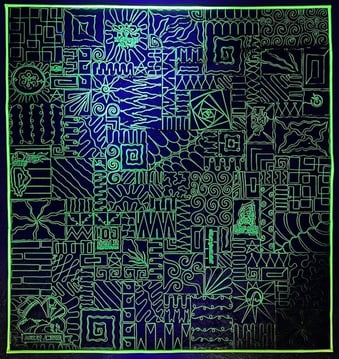
With individual block quilting, each T-shirt block is quilted separately. The quilting design can be chosen to work with the graphic on that particular T-shirt, including outlining or tracing parts of the design.
At Too Cool T-shirt Quilts, we quilt each block individually using non-computerized, freehand long-arm quilting.
Learn more about the different quilting methods used on T-shirt quilts.

A T-shirt quilt has three layers that need to be held together. One method is quilting, where stitches run through all three layers. Another method is tying, where the layers are secured together at intervals with individual ties.
These methods create a very different look and affect how the layers of the quilt are held together.
Learn more about quilting, tying and other methods used to hold T-shirt quilts together.
Horse%20logo%20close%20up%20with%20manetail%20ties.jpg?width=900&height=675&name=c)Horse%20logo%20close%20up%20with%20manetail%20ties.jpg)
Too Cool T-shirt Quilts and Project Repat both turn T-shirts into something you can use, but we don't make the same product. Not even close.
Project Repat makes T-shirt blankets with T-shirt squares on the front and fleece on the back. Too Cool makes three-layer, long-arm quilted T-shirt quilts using different-size blocks based on the graphics on your shirts.
The difference isn't just style or price. The products are constructed differently from the beginning.
See a complete comparison of Too Cool T-shirt Quilts and Project Repat.
T-shirt quilt companies don't all make T-shirt quilts the same way. Differences can include block sizes, whether you have to cut your own shirts, the use of interfacing, quilting methods, design options and the types of materials that can be included.
Too Cool T-shirt Quilts uses a construction method we developed specifically for working with T-shirts. Comparing those differences can help you decide which type of T-shirt quilt and which company is right for you.
See how Too Cool T-shirt Quilts compares with other T-shirt quilt companies.
Searching for “T-shirt quilts near me” may lead you to a local quilt maker, but location isn't the only thing to consider. T-shirt quilts require experience working with stretchy fabrics, graphics of different sizes and a variety of clothing materials.
Compare the type of quilt they make, their construction methods, their experience with T-shirts and examples of their finished work. You may find the right quilt maker nearby, or you may decide it's worth shipping your T-shirts to a company that specializes in T-shirt quilts.
T-shirt quilt prices can vary by hundreds or even thousands of dollars. But you're not always comparing the same product.
Price differences can reflect whether you're buying a quilt or a blanket, how much work you have to do before sending your T-shirts, the construction and quilting methods, materials, customization and the amount of individual design work involved.
Before comparing prices, make sure you understand what you're getting for that price.
Making your own T-shirt quilt can save you the cost of having someone else make it, but it requires time, sewing skills, the right tools and a good understanding of how to work with stretchy T-shirt fabric.
Having a T-shirt quilt professionally made costs more, but the cutting, design, construction and quilting are done for you. Which option is right for you depends on your skills, budget, time and the result you want.
T-shirt blankets cost less than T-shirt quilts, but the difference isn't simply one company charging more than another. They are different products made using different construction methods.
When comparing prices, look at what is included: the number of layers, batting, quilting, backing, how your T-shirts are prepared and cut, and how much individual design work goes into the finished product.
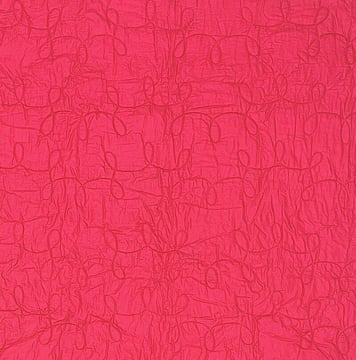
A solid-color backing lets you see the quilting designs on the back of a T-shirt quilt. The quilting can become almost a second design on the quilt.
A patterned backing tends to hide or camouflage the quilting. Your choice depends on whether you want the quilting to be part of the look of the back or prefer the backing fabric itself to be the focus.
The type of batting inside a T-shirt quilt affects how the quilt looks, feels and holds up over time.
100% polyester batting is inexpensive, but it can bunch between quilting lines and the fibers can work their way through the backing. We use a low-loft, needle-punched 80% cotton/20% polyester blend. It is strong, stable and holds up well to repeated use and washing.
The fabric used on the back of a T-shirt quilt affects its weight, feel and how the quilting looks. Cotton, flannel and fleece each create a different finished quilt.
We prefer 100% cotton backing because it is durable, washes well and allows the quilting designs to show clearly on the back.
T-shirt quilt companies use different approaches to producing their quilts. Some use a standardized production system with preset sizes, layouts and ordering options. Others take a custom approach, making design decisions based on the individual T-shirts in each quilt.
These comparisons explain how those different production methods can affect your choices and the finished quilt.
Some T-shirt quilt companies use a manufacturing model designed to produce quilts efficiently using predetermined block sizes, layouts and options. Your T-shirts are made to fit within that system.
A custom T-shirt quilt takes the opposite approach. The design is based on the T-shirts you send, including the size and shape of the graphics. The layout is created specifically for those shirts rather than fitting them into a predetermined format.
See an example of how manufactured and custom T-shirt quilts differ.
Some T-shirt quilts use blocks that are all the same size. Each T-shirt graphic has to fit within that predetermined block size, regardless of whether the design on the shirt is large or small.
Variable-size blocks are cut based on the size and shape of each individual graphic. A small logo can become a small block, while a large graphic can remain large. The different-size blocks are then arranged to fit together in the quilt.
See how variable-size blocks change the design of a T-shirt quilt.
A preset layout uses a predetermined grid. The T-shirt blocks are placed into that existing format, and the arrangement can be repeated from quilt to quilt.
At Too Cool T-shirt Quilts, every layout is designed specifically for the T-shirts in that quilt. We have never used the same layout twice because no two groups of T-shirts are the same. The size, shape, color and graphics on the shirts all influence the final layout.
Some T-shirt quilt companies are set up primarily around an online ordering system. You select your options, place the order and follow the company's process for preparing and sending your T-shirts.
At Too Cool T-shirt Quilts, you fill out an order form telling us what you would like, box up your T-shirts and send them to our shop. If you have questions before you order, need help deciding what to do, or simply feel more comfortable talking with someone first, you can call or email us.
Once your T-shirts arrive, your order and shirts are handled by people, not just moved through an online ordering system.
Some T-shirt quilt companies require full payment when you place your order, before they receive your T-shirts or begin making your quilt.
At Too Cool T-shirt Quilts, you don't pay for your quilt up front. You send us your T-shirts and order form, and we make your quilt. You pay when your quilt is finished and ready to ship.
Our process is built on mutual trust: you trust us with your T-shirts, and we trust you to pay for your quilt when it's finished.
Katy V., Standard T-shirt Quilt
Jack B., Quilts with Borders, 4" Pieced + 2" Solid Border